

EU
In the fast-paced world of modern manufacturing, the materials we handle have changed. We are no longer just moving pallets of bricks or boxes of sturdy spare parts. Today, the warehouse and the production floor are filled with high-value, high-sensitivity materials.
Nowhere is this more evident than in the lithium battery industry. The electrode roll is the heart of the battery. It is expensive. It is delicate. It is heavy. And yet, many facilities still rely on outdated equipment to move these precision items instead of investing in a dedicated Battery Roll Lifter.
If you manage a facility dealing with lithium electrode rolls, varying film materials, or specialized paper, you know the struggle. You face a constant battle against material damage. You fight against limited space. You worry about operator fatigue.
It is time to rethink the logic of how we move these rolls. It is not just about lifting heavy objects; it is about precision, geometry, and protecting your bottom line.
The High Price of a Single Scratch Without a Proper Battery Roll Lifter
Let’s be honest about the costs. A lithium electrode roll is not a cheap commodity. It represents hours of processing time and expensive raw materials.
What happens when a standard forklift interacts with an electrode roll instead of a specialized Battery Roll Lifter? Standard forks are designed for pallets, not cylinders. If an operator tries to lift a roll with forks, the pressure points are all wrong. You risk crushing the outer layers of the film.
Even a minor indentation on the outer layer can ruin hundreds of meters of material. In battery manufacturing, consistency is everything. A dent creates uneven tension. Uneven tension leads to coating defects. Defects lead to scrapped batteries or, worse, safety hazards later in the product’s life.
Then there is the issue of contamination. Many of these rolls are handled in cleanroom environments. Traditional hydraulic equipment is often messy. It leaks. It collects dust. Bringing a dirty, rusty stacker into a clean production zone is a recipe for disaster.
The logic of handling these rolls must prioritize protection above all else. The equipment must touch the roll without hurting it. This usually means engaging the core, not the outer surface, a feature central to any high-quality Battery Roll Lifter.
The Geometry of the “Last Mile”: Why You Need a Battery Roll Lifter
Moving a roll from a truck to a shelf is one thing. Moving it from a shelf to the production machine is a completely different challenge. This is the “last mile” of internal logistics.
Production machines—whether for coating, slitting, or winding—are often crowded together. Space is at a premium. The aisles are narrow.
Standard stackers have a major flaw in this environment: they are front-heavy and wide. To load a machine, the operator often needs to approach from the side. If your stacker has wide straddle legs, you cannot get close enough to the machine shaft.
This leads to dangerous behaviors. Operators might try to manually lift the roll the last few inches. With rolls weighing 80kg or more, this is how back injuries happen. It is also how rolls get dropped.
A dropped roll is a catastrophe. It damages the floor. It risks crushing a foot. It deforms the roll’s core. Once the core is out of round, it will not fit on the machine spindle. The entire roll becomes waste.
The solution requires a change in geometry. We need a Battery Roll Lifter that acts less like a forklift and more like a precise robotic arm. The design must be cantilevered. It needs to reach out without the obstruction of bottom legs blocking the path.
Precision Descent: The Unsung Hero of a Battery Roll Lifter
Most people focus on how much weight a stacker can lift. But for delicate rolls, the most important feature of a Battery Roll Lifter is how it lowers the load.
Imagine you are aligning a heavy roll of film onto a machine spindle. The clearance might be less than a millimeter. You have the roll suspended in the air. You push the “down” lever on a basic manual stacker.
Thud.
The hydraulic valve opens too fast. The roll drops an inch instantly. It slams onto the spindle. This impact can bend the machine shaft. It can jar the internal structure of the roll.
Precision handling requires variable speed. You need a “fast” mode for moving the empty lift up and down to save time. But you need a “micro” or “slow” mode for that final alignment. The operator needs to feel confident. They need to know that if they tap the control on their Battery Roll Lifter, the load will move a fraction of an inch, not a foot.
Control creates safety. When an operator is fighting with the controls, they are not watching their surroundings. When the controls are smooth and predictable, the operator can focus on the task. Accidents go down. Efficiency goes up.
The Ergonomics of a Single Arm Battery Roll Lifter
Why do we see so many two-person teams handling rolls that should be a one-person job? It is usually because the equipment is too hard to use.
Pushing a heavy steel stacker around a warehouse is exhausting. If the wheels are cheap nylon, every crack in the floor sends a jolt through the operator’s arms. If the turning radius is wide, the operator has to make five-point turns just to get out of an aisle.
Fatigue is the enemy of quality. A tired operator makes mistakes. They rush. They cut corners.
The ideal Battery Roll Lifter should be an extension of the operator. It should be nimble. The steering wheels need to rotate freely. The unit needs to be compact enough to spin on its own axis.
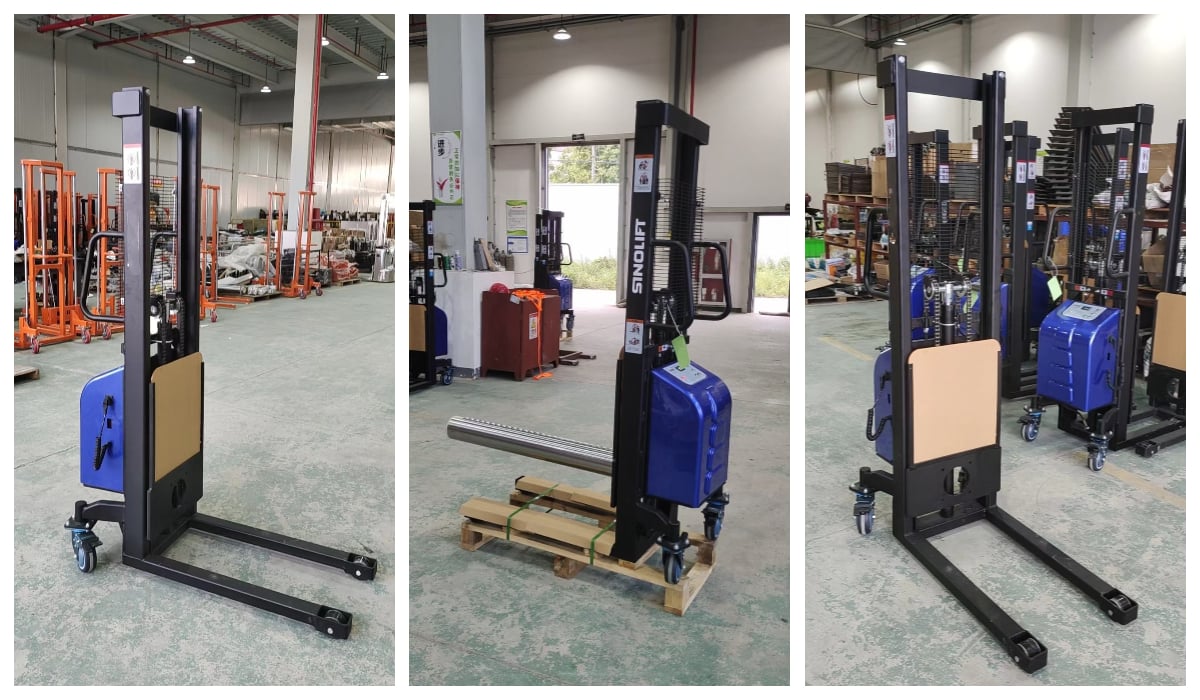
Furthermore, the loading mechanism needs to make sense. A “Single-Arm” or mandrel design is superior here. Instead of trying to balance a round object on two flat forks, you insert a mandrel into the core. Gravity does the work for you. The roll is secure. It cannot roll off.
This single-arm approach also helps with “side loading.” Since there is only one support arm, you can approach a machine from an angle. You can slide the roll off the Battery Roll Lifter and directly onto the machine without ever supporting the weight manually.
Maximizing Efficiency with a Compact Battery Roll Lifter
Let’s talk about floor space. In a modern factory, every square meter costs money. If your equipment requires wide aisles, you are wasting space that could be used for production.
Large, sit-down forklifts are overkill for rolls under 200kg. They are too big. They require huge turning lanes.
Manual pump stackers are small, but they are slow. Pumping a handle fifty times to lift a roll to eye level is a waste of time. It creates a bottleneck.
The “Goldilocks” solution is the compact electric Battery Roll Lifter. It has the power of the big machine but the footprint of the manual one. It fits into the tightest corners of the slitting room. It navigates around pillars and workbenches.
By switching to compact, electric, single-arm stackers, many facilities find they can narrow their aisles. They can fit more inventory in the same space. They improve their storage density without spending a dime on construction.
A New Standard for Clean Handling with Your Battery Roll Lifter
We touched on cleanliness earlier, but it deserves its own focus. In the lithium battery sector, copper and aluminum foil rolls must remain pristine.
Equipment maintenance plays a huge role here. Old-school stackers often have exposed chains and greasy masts. This is a contamination risk.
Modern handling logic demands equipment designed for hygiene. We look for a Battery Roll Lifter with enclosed masts. We look for covers that protect the hydraulic systems from dust, and conversely, protect the environment from the hydraulics.
The materials matter too. A chrome-plated arm is not just for looks. It is hard. It is smooth. It does not flake or chip. It slides easily into the cardboard or plastic core of the roll without generating friction particles.
Introducing the Sinolift ND95C: The Ultimate Battery Roll Lifter
We have discussed the problems: damage to sensitive materials, lack of space, operator fatigue, and the need for precision. Now, let’s look at a machine built specifically to solve these problems.
O Sinolift ND95C Intelligent Single-Arm Mandrel Stacker is the answer for facilities handling lithium electrode rolls, film, and paper. It is not a generic forklift adapted for the job; it is a purpose-built Battery Roll Lifter.
The Intelligent Cantilever Advantage
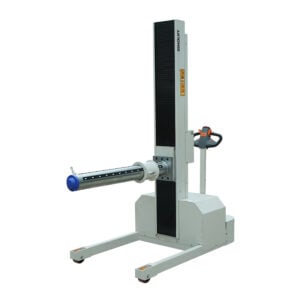
The core of the ND95C is its Single-Arm design. This high-precision cantilever arm is crafted from seamless, chrome-plated steel. It is smooth and durable. It allows your operator to insert the mandrel directly into the roll core. This eliminates contact with the delicate outer layers of your electrode or film rolls. The design enables easy side loading, making it perfect for feeding production machines in tight spaces.
Precision Electric Control
Forget the “thud” of manual hydraulics. The ND95C Battery Roll Lifter features an intelligent control panel with electric lifting. It puts the operator in complete control.
- Three Descent Modes:You can choose between fast, low, or stop modes. This allows for rapid movement when the stacker is empty and micro-precision when you are aligning a heavy roll with a machine spindle.
- Adjustable Speed:The electric lifting is smooth and consistent, removing the physical strain of pumping a handle.
Built for the Narrow Aisle
This machine was engineered for the reality of crowded warehouses. It is incredibly compact. The high-quality PU (Polyurethane) casters are durable and quiet. They provide excellent maneuverability, allowing the ND95C to turn in small radiuses. You can navigate narrow aisles with confidence, ensuring that your workflow never stops due to a traffic jam.
Safety and Durability First
The ND95C is built to last. It uses a high-quality C-type steel mast for superior stability, even when lifting heavy loads. But it also prioritizes the operator. A protective steel mesh separates the operator from the lifting mechanism. Furthermore, a high-transparency, impact-resistant PC dust-proof cover protects the operator from moving parts while keeping the internal components clean—a vital feature for dust-sensitive battery environments.
Reliable Core Performance
Under the hood, the ND95C is just as impressive. It is equipped with a leak-free hydraulic cylinder, addressing the cleanliness concerns of modern manufacturing. The maintenance-free battery ensures that the machine is always ready to work when you are, reducing downtime and upkeep costs.
If you are tired of damaged product and inefficient handling, it is time to upgrade your approach. The ND95C offers the intelligence, size, and gentleness required for modern manufacturing.

 Português
  English
  Español
  Русский
  Türkçe
  Tiếng Việt