
Have you ever calculated the true cost of a single workplace injury?
Most business owners look at the immediate medical bills or the insurance paperwork. However, the real damage goes much deeper. It involves lost production hours, increased insurance premiums, potential legal complications, and—perhaps most damaging of all—a drop in team morale. When an employee gets hurt, the whole warehouse slows down.
In the logistics and manufacturing sectors, the statistics are sobering. Back strains and musculoskeletal disorders (MSDs) remain the most common workplace injuries. These aren’t usually caused by a single dramatic accident. Instead, they are the result of cumulative trauma: the daily grind of lifting, bending, and twisting incorrectly.
This is where the conversation about equipment needs to change. Investing in the right manual winch stacker is not just an operational expense. It is a critical investment in the health of your workforce and the future of your business.
The Hidden Risks in Manual Handling
Before we discuss solutions, we must understand the problem. In many warehouses, manual handling is viewed as “unskilled” labor. The assumption is that if an object needs to be moved, sheer strength is enough. This mindset is dangerous.
Common Workplace Risks Include:
- Overexertion:Trying to lift loads that are too heavy or awkward.
- Repetitive Strain:Performing the same lifting motion hundreds of times a day without mechanical aid.
- Awkward Posture:Bending the spine to pick up goods from floor level or reaching too high above the shoulders.
- Falling Objects:Losing grip on a heavy item, leading to crushed toes or damaged inventory.
The “One-Size-Fits-All” Myth
A common mistake in equipment procurement is the belief that “a lifter is just a lifter.” Buyers often purchase the cheapest manual stacker available without considering the specific environment.
However, using the wrong tool is a safety hazard in itself. Using a wide-leg stacker in a narrow aisle causes collision risks. Conversely, using a narrow, unstable stacker for a wide load creates a tipping hazard. Safety starts with selection.
What Is a Manual Lift Winch Stacker?
Before diving into specific models, it is helpful to define exactly what we are talking about.
A material lift winch stacker is a manually operated tool designed to lift, lower, and position heavy items. Unlike powered forklifts, they rely on a hand-cranked winch system. This gives the operator precise control over the lifting speed and height.
They are essential tools for:
- HVAC installations (lifting units to ceilings).
- Warehouse stocking.
- Maintenance and repair jobs.
- Loading and unloading delivery trucks.
A good manual stacker must be strong enough to do the work, but compact enough to be transported easily.
Three Solutions for Three Safety Scenarios
At Sinolift, we understand that different tasks carry different risks. We have designed our equipment to address specific ergonomic challenges. Here is how three of our key products solve three distinct safety problems.
Scenario 1: The Fatigue Factor
The Problem: Your team moves moderate loads frequently between workbenches. The loads aren’t massive, but the sheer volume of movement is exhausting. Fatigue leads to sloppy technique, which leads to injury.
The Solution: Reducing Physical Strain
For operations requiring speed and agility, heavy equipment is a burden. You need a tool that acts as a natural extension of the worker.
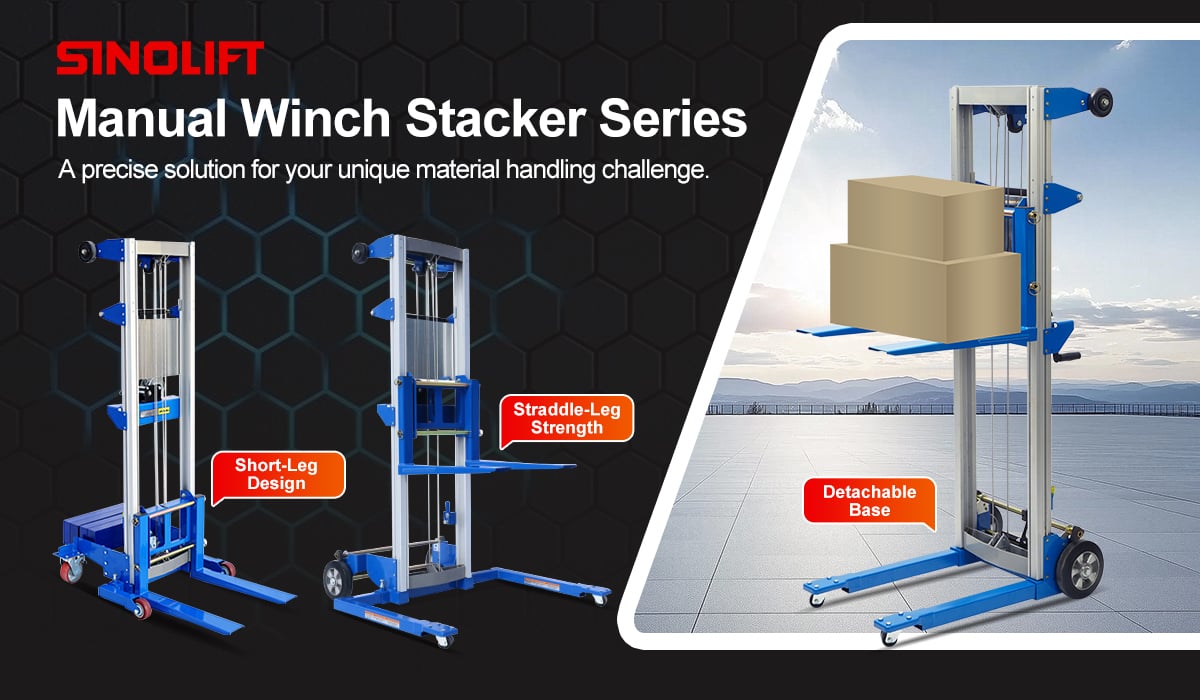
This is where the WFH Series Manual Hand Winch Stacker shines. We designed the WFH series with a specific goal: effortless, one-person operation.
- Lightweight Design:Weighing as little as 51kg, this unit does not fight against the operator. It is easy to push, pull, and position. This significantly reduces the caloric burn and physical fatigue of the operator over an 8-hour shift.
- Precision Control:It features a high-quality manual winch with a safety self-locking mechanism. This is a crucial safety feature. If the operator lets go of the handle, the load stops instantly. There is no risk of the handle spinning out of control or the load crashing down.
- Ergonomic Benefit:By taking the weight of the load (up to 227kg) off the worker’s back, you eliminate the risk of spinal compression. The smooth-swivel casters allow for easy turning, preventing the knee and hip torque associated with dragging heavy equipment.
Scenario 2: The Tipping Hazard
The Problem: You are handling bulky, wide, or irregularly shaped loads. Or perhaps you are lifting heavy pallets to a significant height. The biggest fear here is stability. If a stacker tips, it endangers the operator and anyone nearby.
The Solution: A Stable Foundation
When the load is heavy or wide, stability is your number one safety metric. You need a wider center of gravity.
The SW Series Manual Hand Winch Stacker with Straddle Legs is engineered specifically for this challenge.
- Straddle Leg Design:The “straddle” design means the legs are wider than the forks. With a fork width of up to 1100mm, this unit plants itself firmly on the ground. It provides a solid, wide base that resists tipping, even when the load is slightly off-center.
- Confidence in Lifting:Whether you choose the 181kg or 227kg capacity model, the rigid structure gives the operator confidence. A shaky lift is a dangerous lift. The SW Series remains rigid and secure.
- Versatile Safety:Despite its robust nature, it remains portable. The chassis is detachable, meaning you can transport this safety solution to different job sites in a light truck. It brings warehouse-level stability to remote construction or installation sites.
Scenario 3: The “Squeeze” Risk
The Problem: Your facility has narrow aisles, crowded production lines, or you need to lift items onto countertops. Standard stackers have legs that stick out in front. In tight spaces, these legs trip workers or prevent the machine from getting close enough to the shelf, forcing workers to lean and reach (a major back injury risk).
The Solution: Counterbalance Technology
To get close to the work without the obstruction of front straddle legs, you need a counterbalance design.
The BC Series Counterbalance Hand Winch Stacker allows for “Zero-Reach” access.
- No Front Legs:By using a robust counterweight system at the rear, we eliminated the front support legs found on other models. This allows the BC Series to drive right up against a wall, a machine, or a truck bed.
- Ergonomic Access:Because the machine can press flush against the loading area, the operator does not have to lean over gaps to push the cargo. This keeps the load close to the body’s center of gravity, which is the golden rule of safe lifting.
- High Reach in Tight Spots:This unit can lift up to 3.0 meters. It effectively turns vertical space into usable storage in cramped rooms where a forklift could never fit. The flip-able standard forks add versatility, allowing you to handle different types of materials without changing equipment.
Beyond the Metal – Building a Safety Culture
Buying the right manual winch stacker is the most important step, but it is not the only step. To truly eliminate workplace injuries, equipment must be paired with the right culture.
Even the best equipment requires proper usage to be effective. When you introduce a new Sinolift stacker to your floor, take ten minutes to train your team.
Key Training Points:
- Check the Load Center:Ensure the load is pushed all the way back against the mast. A load sitting on the tips of the forks causes instability.
- Inspect the Winch:Before every shift, give the cable and winch a quick visual check. Our winches are built for durability, but daily checks are a safety best practice.
- Clear the Path:Manual stackers work best on smooth floors. Debris or cracks can cause sudden stops that might shift the load.
Conclusion: An Investment in People
When you choose a manual stacker, you are choosing how your employees interact with their environment.
You can choose a generic tool that requires struggle and strain, or you can choose a purpose-built solution. Whether it is the lightweight agility of the WFH Series, the heavy-duty stability of the SW Series, or the precision access of the BC Series, Sinolift offers a safer way to work.
Reducing workplace injuries doesn’t always require complex robotics or expensive automation. Sometimes, it just requires giving your team a hand—or rather, the right handle to crank.
Ready to improve safety and efficiency in your facility?
Visit our website to view the full specifications of our manual handling solutions, or contact our team today to discuss which series is right for your workspace.

 English
  Español
  Русский
  Português
  Türkçe
  Tiếng Việt